


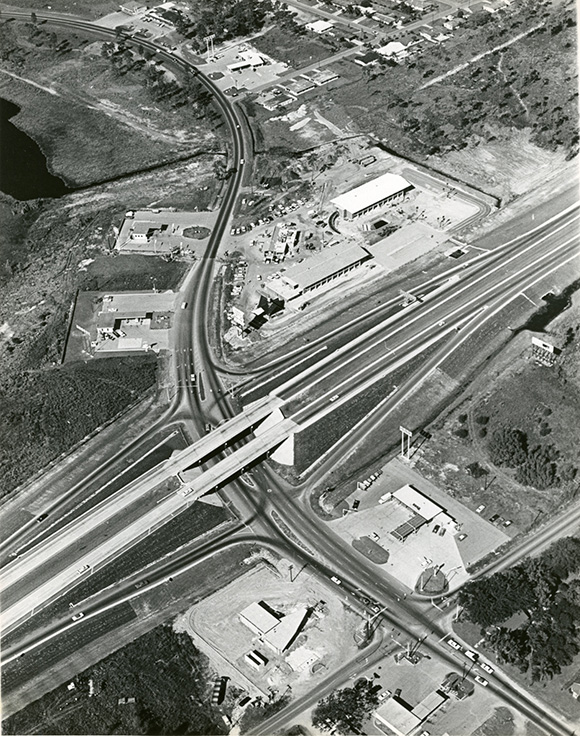
60 Never Looked so Good: Happy Birthday, I-4!
This year marks a big milestone for Interstate 4 (I-4), one of Florida’s busiest highways. I-4 turned 60 in 2025, and like fine wine, it has only gotten better with age. To celebrate our old friend, let’s look at how I-4 came to be, how it’s grown, and where it’s headed next.
I-4’s story began in 1956, when President Dwight D. Eisenhower signed the National Interstate and Defense Highway Act into law. The bill called for 41,000 miles of an interstate highway system to be funded and constructed over a 10-year period, greatly improving travel across the country. In 1958, crews began constructing a highway to connect Tampa, Orlando, and Daytona Beach across Central Florida.
I-4 opened in 1965, stretching more than 130 miles from Tampa to Daytona Beach, but like any young highway, it had a lot of growing up to do. Over the decades, the highway saw widening projects, new interchanges added, and other roadway improvements to keep up with the region’s growth. Some notable projects include:
- I-275 created and I-4 shortened (1971–1973): The western segment of I-4, which ran over the Howard Frankland Bridge to St. Petersburg, was redesignated as I-75 in 1971. Two years later, I-75 was rerouted east of Tampa, and the Tampa–St. Petersburg segment became I-275, a bypass loop of I-75.
- Attractions area upgrades (1990s): Many interchanges near Kissimmee were constructed or upgraded to accommodate increasing traffic demands in the attractions area, supporting Central Florida’s growth as a major tourist destination.
- Exit numbering system changes (2002): I-4, along with most of Florida’s interstates, switched from a sequential exit numbering system to a mileage-based exit numbering system to comply with new Federal Highway Administration (FHWA) requirements.
In 2015, one of the biggest transportation projects in Florida’s history began: I-4 Ultimate. Florida Department of Transportation (FDOT) crews completely rebuilt 21 miles of I-4 from west of Kirkman Road (State Road (S.R.) 435) to east of S.R. 434, modernizing bridges, improving interchanges, and adding I-4 Express, a managed lane system in the center of I-4 that provides more reliable travel times. The I-4 Ultimate project completed in 2022, providing Central Florida drivers with a smoother, safer, and more efficient highway.
Even at 60 years old, I-4 is showing no signs of slowing down. The next chapter is already underway with I-4 Beyond the Ultimate, which is improving and expanding the interstate beyond the limits of the I-4 Ultimate project and extending I-4 Express. Additionally, Moving I-4 Forward will expand improvements on Central Florida’s essential transportation corridor to the west of the I-4 Beyond the Ultimate limits.
From its first mile in 1959 to the advanced highway it is today, I-4 has remained a vital part of Florida’s journey. As we celebrate I-4’s 60th birthday, we also look ahead to the next 60 years of growth, improvements, and safe travel.
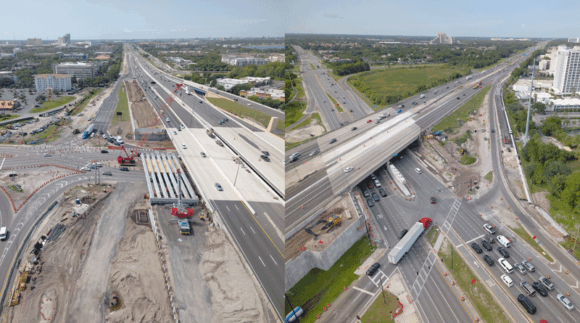 ATTENTION DRIVERS: Overnight I-4 Ramp Closures at the Sand Lake Road and Apopka-Vineland Road Interchanges September 21-24
 Need Help on the Road? Know Who to Call
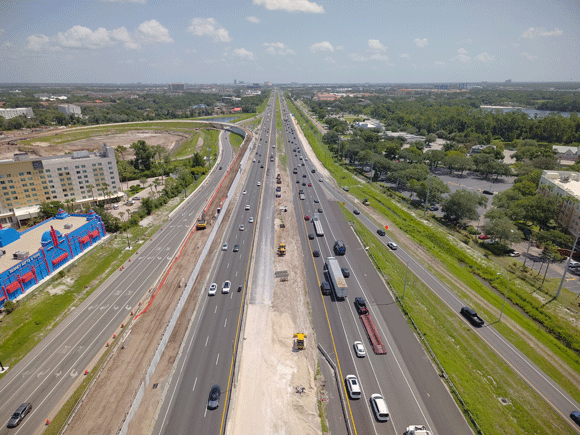 New I-4 Entrance Ramp Configurations from Apopka-Vineland Road Taking Shape
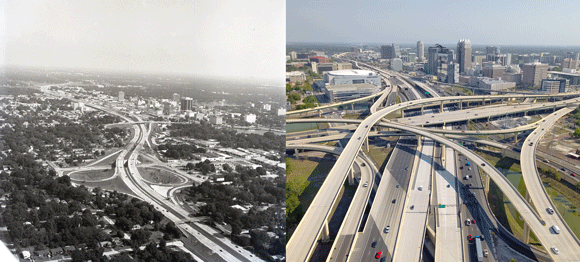 Every Mile Tells a Story: Celebrating 70 Years of the Interstate Highway System